
Physical AI arrives in logistics
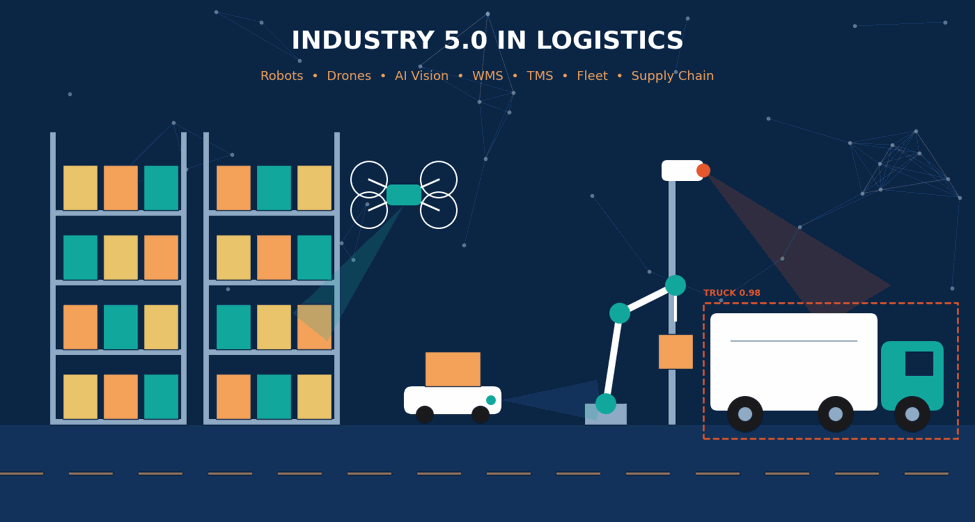
Walk into a modern distribution centre and the picture looks very different from a decade ago. Autonomous mobile robots (AMRs) ferry totes between pick stations. Automated storage and retrieval systems (AS/RS) climb high-bay racks that no forklift driver could safely reach. At night, drones fly the aisles scanning barcodes and RFID tags for cycle counts. At the dock door, AI-enabled cameras measure pallets, read labels and photograph damaged cartons before a truck even pulls away. Out on the road, the same trucks stream telematics data back to a fleet management platform that predicts when a component is about to fail.
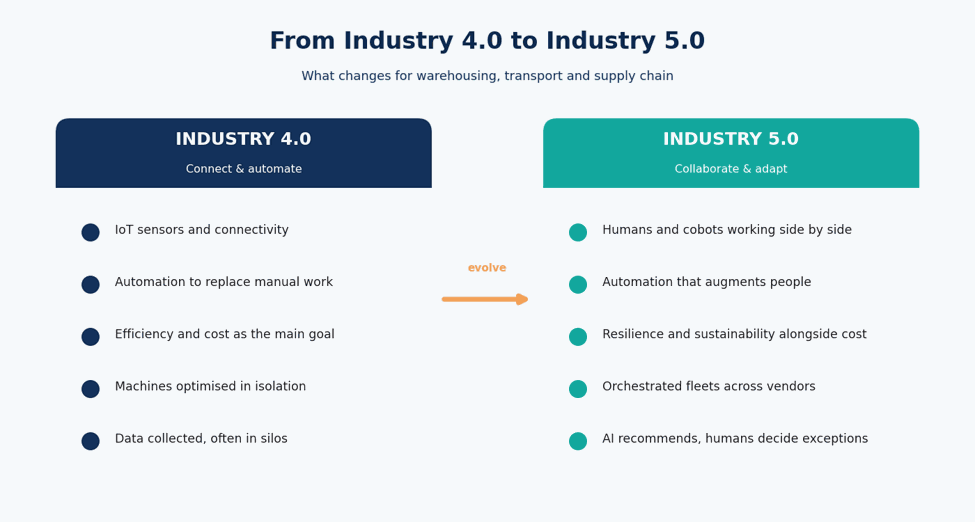
This is not science fiction. Highly automated, even “lights-out”, facilities already exist for specific product flows, and the technology is spreading from early adopters to mainstream operators. What is changing is how the industry thinks about it. Industry 4.0 was about connecting and automating. Industry 5.0 puts people, resilience and sustainability back at the centre, with machines designed to work alongside humans rather than simply replace them.
For warehouse, transport and supply chain leaders, the question is no longer whether to automate. It is how to combine people, machines and data in a way that is safe, financially sound and able to absorb the next disruption.
The business problem: labour, speed and complexity
Three pressures are pushing logistics toward autonomy at the same time.
Labour. Warehouse roles are physically demanding, often involve night shifts, and suffer from high turnover. Transport faces its own constraint: the American Trucking Associations (ATA) put the shortage of qualified truck drivers in the United States at 78,800 in 2022. ATA’s chief economist has since argued that the real issue is the quality of available drivers (safety records, compliance, experience) rather than raw headcount. That distinction matters, because it is exactly the kind of problem that AI-assisted coaching and monitoring can help address.
Speed. Customers now expect same-day or next-day delivery as standard, and they expect to track every step. That compresses the time available for picking, packing, loading and routing.
Complexity. SKU counts keep growing, omnichannel fulfilment mixes store replenishment with individual parcels, returns volumes are rising, and geopolitical and weather disruptions have become routine rather than exceptional.
The result: logistics operations that were built on labour are becoming more capital-intensive and more data-intensive, with autonomous machines filling gaps that people either cannot or should not fill.
Industry 4.0 vs. Industry 5.0: what is actually changing
Industry 4.0 gave logistics the building blocks: IoT sensors, cloud platforms, big data and automation. Its primary goal was efficiency, and it often optimised machines in isolation.
Industry 5.0, a concept promoted by the European Commission from 2021, builds on that foundation with three priorities: it should be human-centric, resilient and sustainable. In a logistics context, that translates into collaborative robots that take on heavy lifting and repetitive walking while people handle judgment and exceptions; energy-aware routing and equipment scheduling; and systems designed to keep working when a supplier, a port or a road network fails.
The technology stack: robots, drones, sensors and AI vision
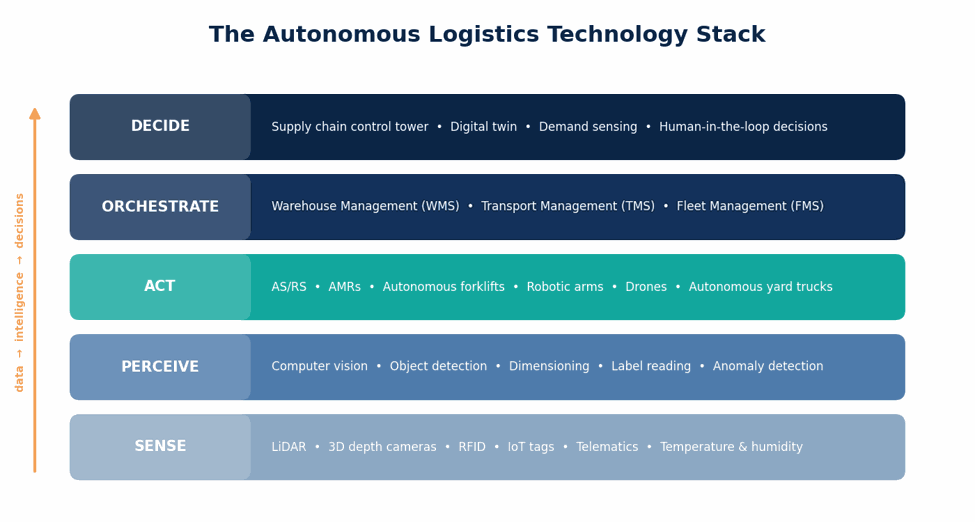
It helps to think of autonomous logistics as a layered stack, where each layer feeds the next.
Fully automatic systems
These run with minimal human intervention inside defined zones: AS/RS and shuttle systems, AMRs and automated guided vehicles, autonomous forklifts and pallet movers, robotic sortation and palletising, and autonomous yard tractors that shuttle trailers between the yard and dock doors.
Semi-automatic and collaborative systems
Here humans and machines share the work. Goods-to-person stations bring shelves or totes to a picker. Robotic picking arms handle standard items and hand exceptions to a person. Follow-me carts, pick-to-light systems and wearable exoskeletons reduce walking and strain. This is where the Industry 5.0 philosophy is most visible.
Drones
Inside the warehouse, drones are well suited to cycle counting high-bay racks, where they scan barcodes or RFID tags far faster and more safely than a person on a lift. Outside, they are used for yard and perimeter inspection, and for delivery pilots where aviation regulations allow.
Sensors and AI-enabled cameras
LiDAR, 3D depth cameras, RFID readers, IoT tags and environmental sensors give machines their awareness. Computer vision turns that raw data into action. Common uses include:
• Pallet and parcel dimensioning, plus automatic label and barcode reading
• Damage detection at inbound and outbound docks, with photo evidence for claims
• Safety monitoring: PPE compliance, exclusion zones and forklift–pedestrian proximity alerts
• Trailer fill-rate and loading-quality monitoring
• AI dashcams that detect driver fatigue and distraction in real time
The key point is that machines are only as valuable as the systems orchestrating them. A fleet of robots without a smart WMS is just expensive hardware.
How Industry 5.0 transforms the core systems
Warehouse Management Systems (WMS)
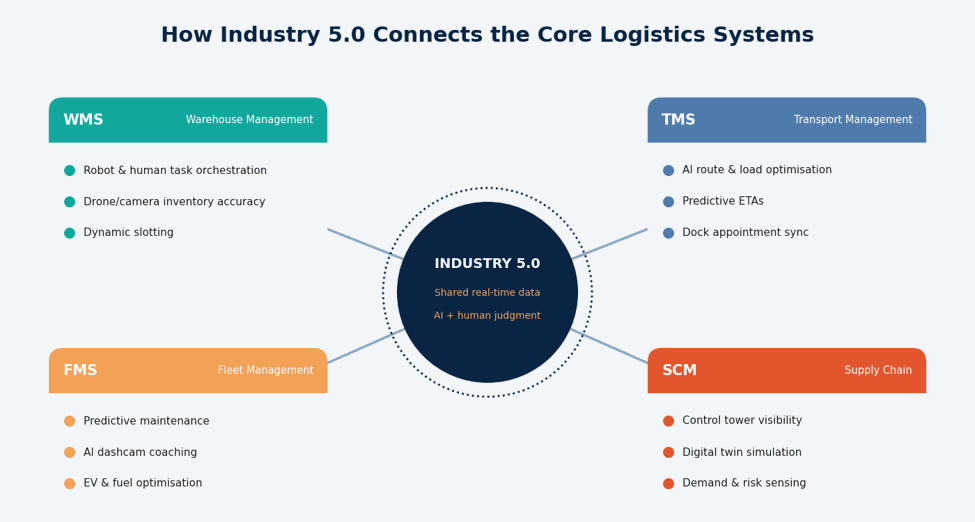
The WMS is evolving from a system of record into a system of orchestration. Instead of simply tracking where stock sits, it now decides which tasks go to robots and which go to people, based on capability, cost and ergonomics. Drone and camera data push inventory accuracy toward real time, which enables dynamic slotting: moving fast sellers closer to dispatch as demand shifts. A human-centric WMS also factors in fatigue, skills and training when assigning work.
Transport Management Systems (TMS)
AI brings route and load optimisation that adapts during the day, not just at planning time. Live telematics and traffic data feed predictive ETAs. Carrier selection can weigh cost, reliability and emissions together. Crucially, a modern TMS syncs dock appointments with the WMS, so trucks arrive when the warehouse is actually ready to load them. It is also where businesses will prepare for autonomous hub-to-hub trucking as it matures.
Fleet Management Systems (FMS)
Engine and component sensors enable predictive maintenance, reducing breakdowns and roadside delays. AI dashcams provide in-cab alerts and coaching, directly addressing the driver-quality problem. For fleets moving to electric vehicles, the FMS manages charging schedules and range planning. It also handles fuel optimisation and compliance tasks such as hours-of-service tracking.
The wider supply chain
At the top of the stack, a supply chain control tower combines data from warehouses, fleets, suppliers and customers into a single view. Digital twins let teams simulate a disruption, or test a new robot layout, before committing capital. Demand sensing and supplier risk monitoring help the business respond early. The Industry 5.0 twist is simple but important: the system recommends, and people decide on the exceptions.
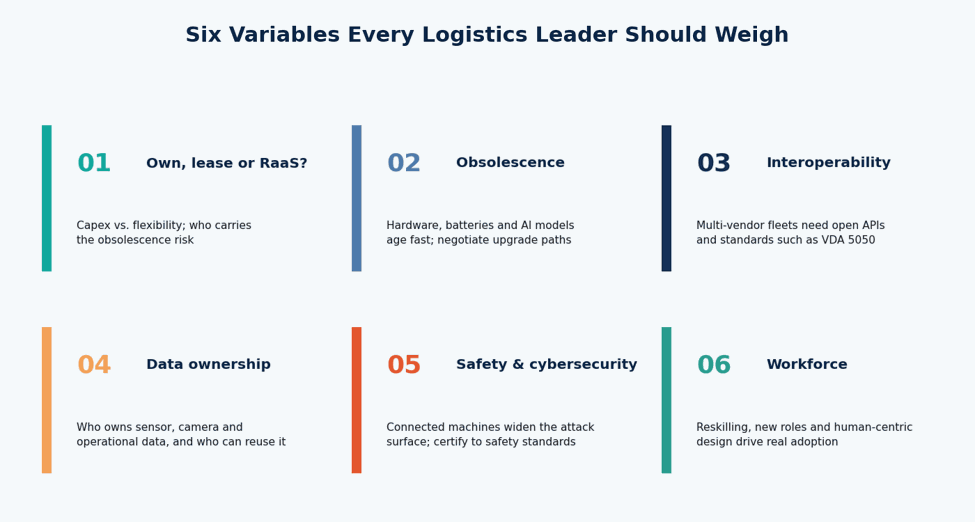
Six variables every logistics leader should weigh
Autonomy creates real value, but the outcome depends heavily on a handful of decisions made early.
1. Own, lease or Robot-as-a-Service?
Buying robots outright adds assets to the balance sheet and can strengthen access to credit. Leasing or Robot-as-a-Service (RaaS) lowers the upfront spend, lets capacity flex with seasonal peaks, and shifts some obsolescence risk to the vendor. Many operators will end up with a mix: owning core infrastructure such as AS/RS while renting AMRs for peak season.
2. Obsolescence
Robot hardware, drone batteries and the AI models behind cameras all evolve quickly. If a machine is effectively obsolete in three years, its resale value and collateral value will be limited. Contracts should cover upgrade paths, software and security support, spare parts availability and clear end-of-life terms.
3. Interoperability
Few operators will buy everything from one vendor. Mixed fleets need open APIs into the WMS and TMS, and common communication standards such as VDA 5050 for AGVs and AMRs. Without that, each vendor becomes an island, and the orchestration benefits disappear.
4. Data ownership and privacy
Robots, drones and cameras generate enormous volumes of operational data, much of which reflects hard-won process know-how. Clarify who owns it, whether vendors can use it to train general models, and whether it could be combined with competitors’ data. Cameras that monitor people also raise privacy and trust questions under data protection laws such as GDPR, so involve legal and HR teams early.
5. Safety and cybersecurity
Every connected machine widens the attack surface. Security patching, network segmentation and incident response need to be designed in, not bolted on. On the physical side, relevant safety standards (for example ISO 3691–4 for driverless industrial trucks) and local drone regulations must be part of the deployment plan.
6. Workforce
Automation changes jobs more than it simply removes them. New roles appear: robot technicians, automation supervisors, fleet data analysts and exception handlers. Human-centric design, reskilling and honest communication are what turn a technology rollout into real adoption on the floor.
The financial and balance sheet impact
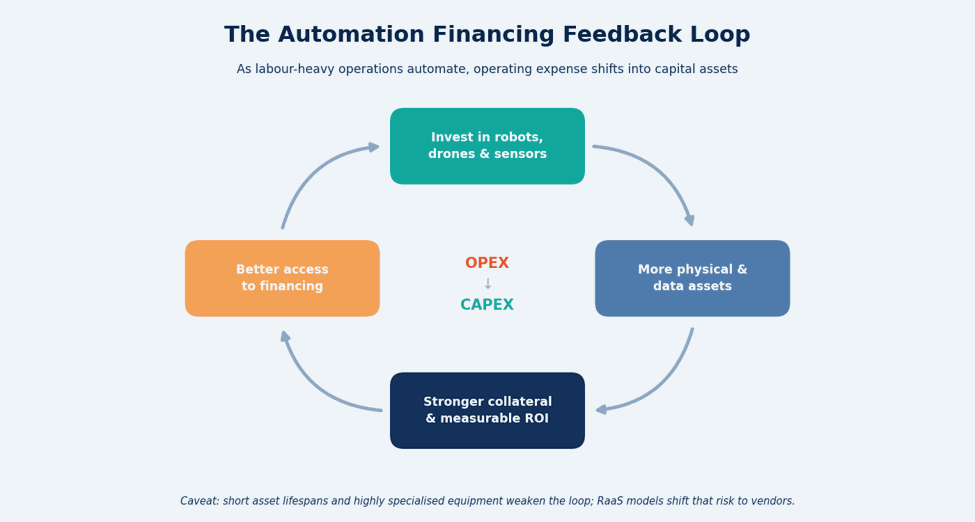
As operations automate, spending shifts from operating expense (wages, overtime, agency labour) to capital expenditure (robots, drones, sensors and software). That creates more physical and data assets in the business, which in turn can support stronger collateral and better access to financing, allowing further investment. It is a potential feedback loop.
The loop is not automatic, though. Highly specialised equipment, like a conveyor system built for one building, has a thin resale market. General-purpose machines such as AMRs and drones can be redeployed across sites and industries, which makes them more attractive to lenders. Short asset lifespans also weaken the case for ownership, which is why RaaS can be the better fit for some operators and can support a “capital-light” story with lenders who focus on cash flow.
Whatever the model, measure return on investment beyond labour savings alone. Order accuracy, throughput, dock-to-stock time, safety incidents, damage claims, fuel use and carbon emissions all belong in the business case.
What this looks like in practice
The following scenarios illustrate deployments that are increasingly common across the industry:
• Night-time drone inventory. Drones scan high-bay locations after the last shift, and the WMS flags discrepancies for a human to resolve the next morning.
• Smart dock doors. AI cameras capture pallet dimensions, verify labels and photograph condition at handover, cutting disputes over damaged freight.
• Autonomous yard moves. A driverless yard tractor shuttles trailers between parking and dock doors on instructions from the TMS and yard management system.
• Coached drivers. AI dashcams alert drivers to fatigue or distraction in the moment, and the FMS turns patterns into targeted coaching.
• Peak-season rehearsal. A digital twin of the network tests staffing, robot counts and carrier capacity against forecast volumes before the peak arrives.
How to prepare: a roadmap for logistics leaders
The most successful programmes move in deliberate phases rather than one big-bang deployment.
• Assess. Map processes, pain points and data readiness. Identify where labour is scarcest or risk is highest.
• Pilot. Choose one high-value use case with clear KPIs and a defined time frame.
• Integrate. Connect the pilot to the WMS, TMS and FMS, and add an orchestration layer so machines and people share one task queue.
• Scale. Extend to more sites and vendors, and choose the right ownership and financing model.
• Optimise. Use digital twins and operational data for continuous improvement, and keep investing in reskilling.
None of this belongs to a single department. Operations, IT, safety, finance, HR, legal and procurement all need a seat at the table, alongside robotics and data specialists.
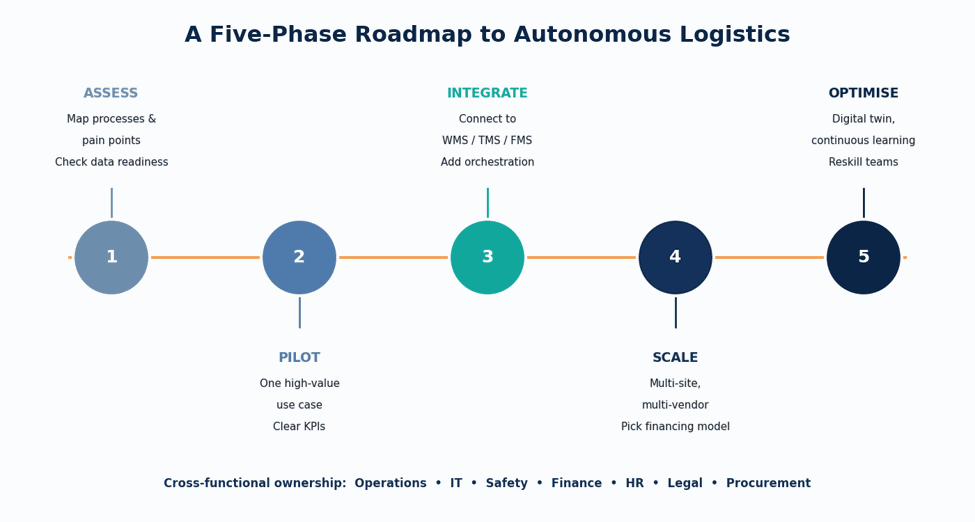
A phased roadmap reduces risk and builds the internal expertise needed to scale.
Conclusion: humans and machines, together
Robots, drones and AI vision are no longer experiments at the edge of logistics. They are becoming part of the operational core, and they are reshaping how warehouses run, how fleets move and how supply chains respond to shocks.
The winners will not be the companies that automate the most. They will be the ones that combine machine precision with human judgment, make sound decisions about ownership, data and safety, and bring their people along for the journey. That is the real promise of Industry 5.0: supply chains that are not only faster and cheaper, but also safer, more resilient and more sustainable.
What part of your operation would benefit most from autonomy today? Share your thoughts in the comments.
This article was originally published on Medium by Ponvannan P.